Independent writing on tax-smart planning, mortgage strategy, and retirement building. For Canadian professionals who want the whole picture, not just a piece of it.
The Bank of Canada's Rate Cuts Were Easy. The Hikes Will Be Impossible.
The Bank of Canada cut its policy rate five times in seven months, from 5% down to 3.25% by December 2025, and the economy barely flinched. Mortgage renewals got cheaper. Business borrowing costs dropped. Inflation stayed pinned near 2%. Nobody panicked. Nobody had to. Lowering rates when the economy is soft is mechanically simple: you're removing a brake that wasn't needed in the first place.
Raising them again will be a different problem entirely.
The arithmetic that made cuts easy is the same arithmetic that will make hikes impossible. Canadian households carry roughly $1.76 of debt for every dollar of disposable income, the highest ratio in the G7. Most mortgages renew every five years or less, so rate changes hit household budgets fast and hard. When the Bank of Canada raised rates by 475 hundredths of a percentage point between March 2022 and July 2023, homeowners felt it within months. Per capita GDP went negative. Consumer spending stalled. The "soft landing" everyone talks about was actually a per capita recession dressed up in population growth.
That sensitivity cuts both ways. It made inflation come down faster than in the U.S., where 30-year fixed mortgages insulate borrowers from rate moves for decades. But it also means the Bank of Canada cannot tighten policy the way the Federal Reserve can. The Fed raised rates to 5.5% and held them there for over a year. If the Bank of Canada tried the same move, mortgage renewals alone would crater consumption across the country. The economy isn't built to absorb that kind of squeeze twice in five years.
The trade and immigration ceiling
Two structural forces make the problem worse. Federal policy is cutting the share of non-permanent residents, temporary workers and students, from current levels down to 5% of the population by 2027. That's a demographic headwind. For years, Canada's GDP stayed positive mostly because there were more people. Strip out population growth and the per capita story has been recessionary since mid-2022. Slower immigration means slower aggregate growth, which means less room for the Bank of Canada to raise rates without tipping the economy into outright contraction.
At the same time, trade uncertainty with the U.S. has business investment stuck in neutral. Canadian companies have underinvested in machinery and equipment for years compared to American competitors, and the threat of new tariffs or border friction makes that gap worse. If exports weaken or cross-border supply chains get more expensive, the Bank of Canada will face pressure to keep rates lower just to offset the damage. A central bank cannot fix trade policy with interest rates, but it will be forced to react to it.
The neutral zone is not neutral
The Bank of Canada estimates its neutral rate, the level where policy neither stimulates nor restricts, at 2.25% to 3.25%. The policy rate is already inside that range. If inflation stays anchored at 2%, the Bank has no reason to move higher. But if inflation resurges, even modestly, the Bank will face an impossible choice: raise rates into a soft economy and risk a real recession, or hold steady and let inflation drift above target.
The Federal Reserve doesn't face this trade-off as sharply because American households are less rate-sensitive. The Bank of Canada does, and it has no good answer. Cutting rates when the economy needed support was easy because the downside risk was minimal. Raising them again when households are this leveraged, immigration is slowing, and trade is fragile would break something. The Bank of Canada knows it. The market knows it. And that asymmetry, easy cuts, impossible hikes, defines the next two years of Canadian monetary policy.


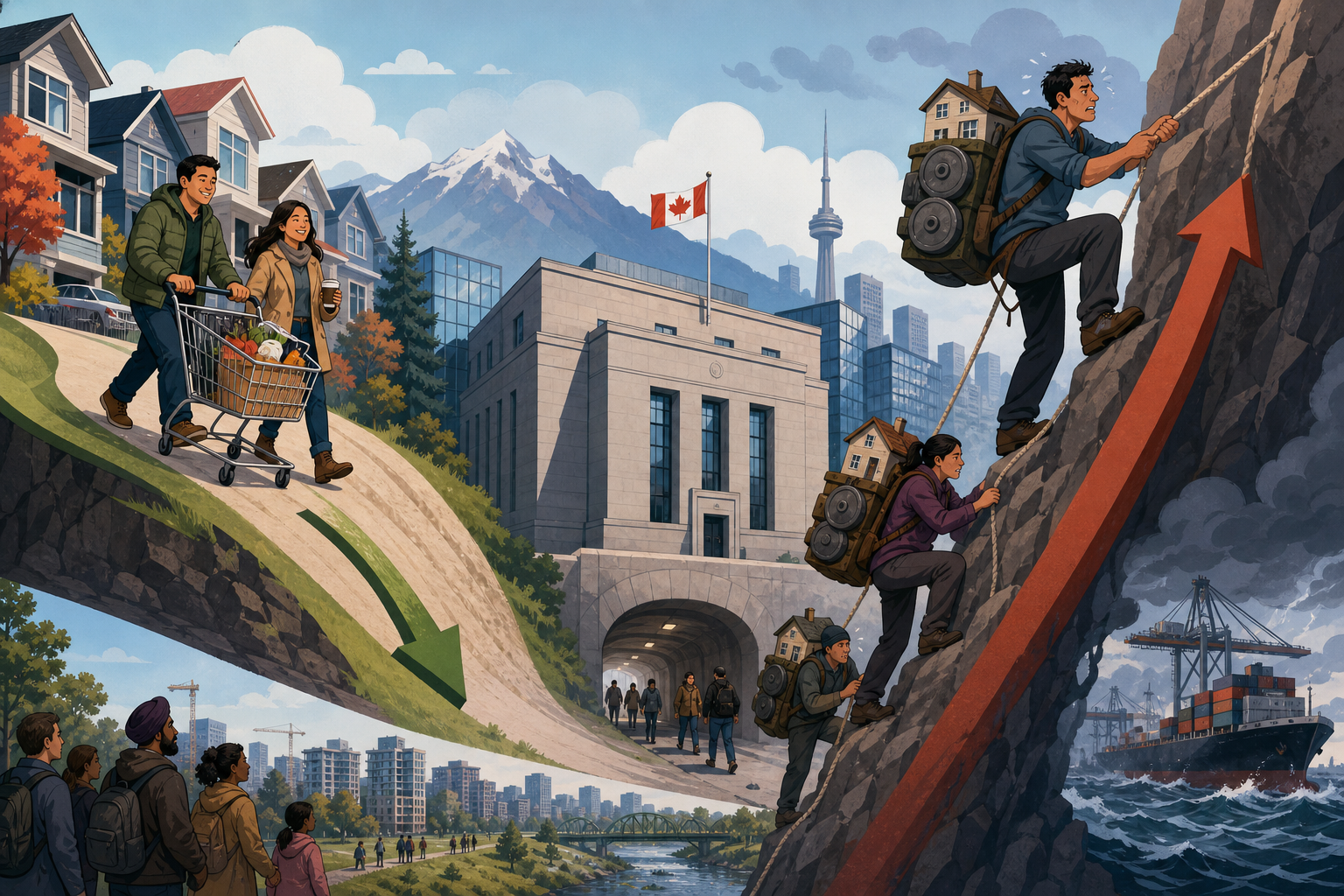

The Bank of Canada cut its policy rate five times in seven months, from 5% down to 3.25% by December 2025, and the economy barely flinched. Mortgage renewals got cheaper. Business borrowing costs dropped. Inflation stayed pinned near 2%. Nobody panicked. Nobody had to. Lowering rates when the economy is soft is mechanically simple: you're removing a brake that wasn't needed in the first place.
Raising them again will be a different problem entirely.
The arithmetic that made cuts easy is the same arithmetic that will make hikes impossible. Canadian households carry roughly $1.76 of debt for every dollar of disposable income, the highest ratio in the G7. Most mortgages renew every five years or less, so rate changes hit household budgets fast and hard. When the Bank of Canada raised rates by 475 hundredths of a percentage point between March 2022 and July 2023, homeowners felt it within months. Per capita GDP went negative. Consumer spending stalled. The "soft landing" everyone talks about was actually a per capita recession dressed up in population growth.
That sensitivity cuts both ways. It made inflation come down faster than in the U.S., where 30-year fixed mortgages insulate borrowers from rate moves for decades. But it also means the Bank of Canada cannot tighten policy the way the Federal Reserve can. The Fed raised rates to 5.5% and held them there for over a year. If the Bank of Canada tried the same move, mortgage renewals alone would crater consumption across the country. The economy isn't built to absorb that kind of squeeze twice in five years.
The trade and immigration ceiling
Two structural forces make the problem worse. Federal policy is cutting the share of non-permanent residents, temporary workers and students, from current levels down to 5% of the population by 2027. That's a demographic headwind. For years, Canada's GDP stayed positive mostly because there were more people. Strip out population growth and the per capita story has been recessionary since mid-2022. Slower immigration means slower aggregate growth, which means less room for the Bank of Canada to raise rates without tipping the economy into outright contraction.
At the same time, trade uncertainty with the U.S. has business investment stuck in neutral. Canadian companies have underinvested in machinery and equipment for years compared to American competitors, and the threat of new tariffs or border friction makes that gap worse. If exports weaken or cross-border supply chains get more expensive, the Bank of Canada will face pressure to keep rates lower just to offset the damage. A central bank cannot fix trade policy with interest rates, but it will be forced to react to it.
The neutral zone is not neutral
The Bank of Canada estimates its neutral rate, the level where policy neither stimulates nor restricts, at 2.25% to 3.25%. The policy rate is already inside that range. If inflation stays anchored at 2%, the Bank has no reason to move higher. But if inflation resurges, even modestly, the Bank will face an impossible choice: raise rates into a soft economy and risk a real recession, or hold steady and let inflation drift above target.
The Federal Reserve doesn't face this trade-off as sharply because American households are less rate-sensitive. The Bank of Canada does, and it has no good answer. Cutting rates when the economy needed support was easy because the downside risk was minimal. Raising them again when households are this leveraged, immigration is slowing, and trade is fragile would break something. The Bank of Canada knows it. The market knows it. And that asymmetry, easy cuts, impossible hikes, defines the next two years of Canadian monetary policy.
Sources
Read Next
7 Fall Home Maintenance Tasks That Prevent Winter Damage and May Lower Your Insurance Costs
Mining and metals claimed 7 of Canada's 10 top-performing stocks in Q3 2026
Canada's foreign buyer ban expires in three months and nobody knows what happens next
Ontario Will Miss 1.5 Million Homes by 2031 Without Zoning and Code Reform