Independent writing on tax-smart planning, mortgage strategy, and retirement building. For Canadian professionals who want the whole picture, not just a piece of it.
What a Level 2 Home EV Charger Actually Costs to Install in Ontario in 2026
A 2024 Nissan Leaf sitting in your garage on a half charge costs you less than $2 in electricity to fill at the Ultra-Low Overnight rate. The same car, plugged into a standard wall outlet, takes 22 hours to reach full. That gap is what makes a Level 2 charger the default for anyone earning six figures who doesn't want to plan their driving day around a cord.
Here's the actual cost breakdown for installing one in Ontario in 2026, based on what Licensed Electrical Contractors are quoting right now.
The Hardware Is the Cheap Part
The charger unit itself runs $600 to $1,200 depending on whether you want smart features (scheduling, energy tracking, load management). A basic 40-amp hardwired unit from a known brand, FLO, ChargePoint, Wallbox, costs around $800. The premium models hit $1,200 and include Wi-Fi connectivity and detailed energy reports, which matter if you're writing off vehicle costs against business income. Cable length matters: a 25-foot cable costs $100 more than an 18-foot one, and if your panel is on the opposite side of the garage from where you park, that extra length is non-negotiable.
The Installation Cost Depends on Three Things
Basic installation, where the electrical panel is already in the garage or within 20 feet of the parking spot, costs $800 to $1,500. That includes the 240V circuit, the breaker, the conduit run, and the permit. The Electrical Safety Authority (ESA) requires a permit for every EV charger install in Ontario, which runs $100 to $200 depending on the municipality. Your homeowner's insurance will ask for proof of the ESA inspection certificate. If you skip the permit to save money, you've just built an uninsurable fire hazard.
The second cost variable is your panel's capacity. Most Ontario homes built before 1990 have 100-amp service. A Level 2 charger typically draws 40 to 50 amps. Add that to your existing load, furnace, water heater, stove, dryer, and you're over. Upgrading to 200-amp service costs $2,500 to $5,000 depending on how far the utility connection is from the house and whether the meter base needs replacing. That's the single largest expense in the process, and it's non-optional if your panel is already near capacity.
The third variable is distance. If your panel is in the basement and your driveway is 60 feet away on the other side of the house, the electrician is running conduit through walls, under concrete, or along the exterior. Outdoor-rated pedestals and trenching under walkways push the bill toward $3,000 even without a panel upgrade. Urban homes in older Toronto neighbourhoods hit this scenario constantly.
Load Management Is Cheaper Than a Panel Upgrade
If your panel is sitting at 90 amps and you don't want to spend $4,000 on an upgrade, a load-sharing device solves it for around $1,000. These units, sometimes called "Energy Managers", pause the EV charger when high-draw appliances like the dryer or stove kick on. You plug in overnight, the system watches your load in real time, and the car still finishes charging by morning because those appliances aren't running at 2 a.m. anyway. It's a smarter financial move than upgrading if you're only slightly under the threshold.
The Real ROI Is Liquidity
The 2035 federal mandate means every new car sold in nine years is zero-emission. A pre-installed Level 2 charger is becoming a standard selling feature, the way a second bathroom or central air became one in the 1980s. Pre-installed Level 2 chargers are becoming a standard selling feature in higher-end markets, where dual-income tech and finance buyers increasingly expect EV infrastructure already in place.
The total cost, assuming basic installation and no panel upgrade, is $1,400 to $2,700. Add a panel upgrade and you're at $4,500 to $8,500. Cold-weather efficiency drops in January, so size the circuit higher than you think you need, a 50-amp circuit for a 40-amp charger leaves headroom when the battery is working harder to stay warm.


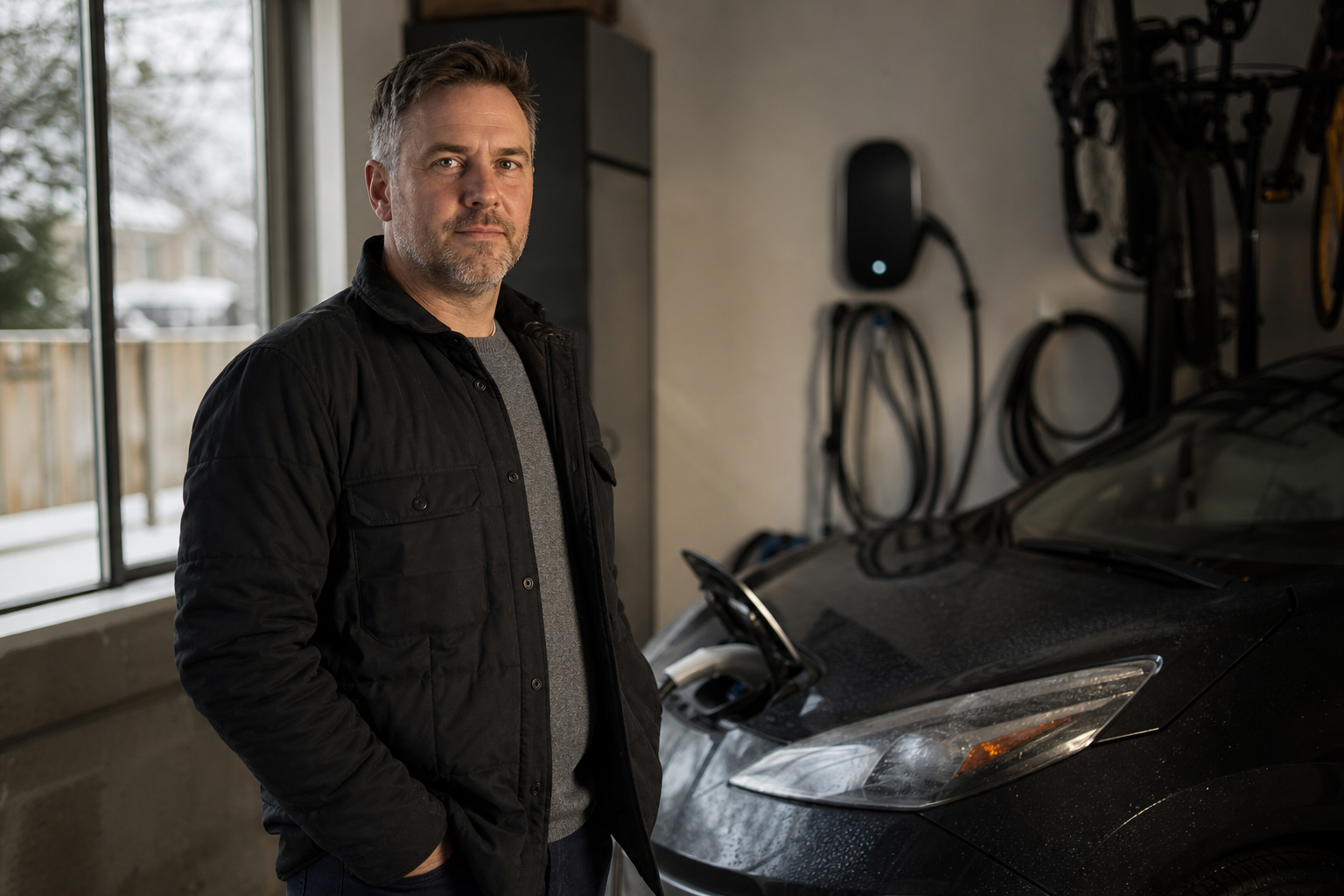

A 2024 Nissan Leaf sitting in your garage on a half charge costs you less than $2 in electricity to fill at the Ultra-Low Overnight rate. The same car, plugged into a standard wall outlet, takes 22 hours to reach full. That gap is what makes a Level 2 charger the default for anyone earning six figures who doesn't want to plan their driving day around a cord.
Here's the actual cost breakdown for installing one in Ontario in 2026, based on what Licensed Electrical Contractors are quoting right now.
The Hardware Is the Cheap Part
The charger unit itself runs $600 to $1,200 depending on whether you want smart features (scheduling, energy tracking, load management). A basic 40-amp hardwired unit from a known brand, FLO, ChargePoint, Wallbox, costs around $800. The premium models hit $1,200 and include Wi-Fi connectivity and detailed energy reports, which matter if you're writing off vehicle costs against business income. Cable length matters: a 25-foot cable costs $100 more than an 18-foot one, and if your panel is on the opposite side of the garage from where you park, that extra length is non-negotiable.
The Installation Cost Depends on Three Things
Basic installation, where the electrical panel is already in the garage or within 20 feet of the parking spot, costs $800 to $1,500. That includes the 240V circuit, the breaker, the conduit run, and the permit. The Electrical Safety Authority (ESA) requires a permit for every EV charger install in Ontario, which runs $100 to $200 depending on the municipality. Your homeowner's insurance will ask for proof of the ESA inspection certificate. If you skip the permit to save money, you've just built an uninsurable fire hazard.
The second cost variable is your panel's capacity. Most Ontario homes built before 1990 have 100-amp service. A Level 2 charger typically draws 40 to 50 amps. Add that to your existing load, furnace, water heater, stove, dryer, and you're over. Upgrading to 200-amp service costs $2,500 to $5,000 depending on how far the utility connection is from the house and whether the meter base needs replacing. That's the single largest expense in the process, and it's non-optional if your panel is already near capacity.
The third variable is distance. If your panel is in the basement and your driveway is 60 feet away on the other side of the house, the electrician is running conduit through walls, under concrete, or along the exterior. Outdoor-rated pedestals and trenching under walkways push the bill toward $3,000 even without a panel upgrade. Urban homes in older Toronto neighbourhoods hit this scenario constantly.
Load Management Is Cheaper Than a Panel Upgrade
If your panel is sitting at 90 amps and you don't want to spend $4,000 on an upgrade, a load-sharing device solves it for around $1,000. These units, sometimes called "Energy Managers", pause the EV charger when high-draw appliances like the dryer or stove kick on. You plug in overnight, the system watches your load in real time, and the car still finishes charging by morning because those appliances aren't running at 2 a.m. anyway. It's a smarter financial move than upgrading if you're only slightly under the threshold.
The Real ROI Is Liquidity
The 2035 federal mandate means every new car sold in nine years is zero-emission. A pre-installed Level 2 charger is becoming a standard selling feature, the way a second bathroom or central air became one in the 1980s. Pre-installed Level 2 chargers are becoming a standard selling feature in higher-end markets, where dual-income tech and finance buyers increasingly expect EV infrastructure already in place.
The total cost, assuming basic installation and no panel upgrade, is $1,400 to $2,700. Add a panel upgrade and you're at $4,500 to $8,500. Cold-weather efficiency drops in January, so size the circuit higher than you think you need, a 50-amp circuit for a 40-amp charger leaves headroom when the battery is working harder to stay warm.
Sources
Read Next
7 Fall Home Maintenance Tasks That Prevent Winter Damage and May Lower Your Insurance Costs
Mining and metals claimed 7 of Canada's 10 top-performing stocks in Q3 2026
Canada's foreign buyer ban expires in three months and nobody knows what happens next
Ontario Will Miss 1.5 Million Homes by 2031 Without Zoning and Code Reform